
Crypto Exchanges That Support Monero After the Delistings
After the 2024–2025 wave of delistings, Monero (XMR) is no longer listed on many large centralized exchanges. As of 1 September 2026, users can still access XMR through a smaller group of centralized platforms, accountless instant swap services, P2P markets and atomic-swap tools. Liquidity is more fragmented, and operational responsibility has shifted toward the user. Availability must be re-checked on the day of use.
Disclaimer
This article is for informational purposes only and does not constitute financial, legal or investment advice. Cryptocurrency involves risk of loss. Exchange policies, pair availability and verification rules change. Always confirm the live interface and official documentation before sending funds. Users may have tax and reporting obligations depending on their jurisdiction. Last reviewed / Status checked: 1 September 2026.
Table of Contents
- Why Did Exchanges Delist Monero?
- What Did the Monero Delistings Change for Users?
- Which Major Exchanges Delisted Monero and When?
- Where Can You Still Swap XMR in 2026?
- Current Support Status Snapshot — 1 September 2026
- Accountless Instant Swap Services That Still Support XMR
- Which Centralized Exchanges Still List Monero?
- P2P and Atomic-Swap Routes
- Practical Steps and Risks
- FAQ
Why Did Exchanges Delist Monero?
Between 2024 and 2025 a significant number of centralized exchanges removed Monero trading pairs.
The most visible cases included OKX in January 2024, Binance’s global spot delisting in February 2024, and Kraken’s progressive restrictions that culminated in the removal of XMR for European Economic Area users later in 2024.
Further delistings and regional restrictions continued during 2025, although their scope varied by platform and jurisdiction.
Regulatory and compliance pressure is widely considered a major factor, although individual exchange announcements did not always provide a detailed reason for delisting XMR.
Monero’s protocol features — ring signatures, stealth addresses and confidential transactions — make it difficult for custodial services to obtain the sender, recipient and amount data that certain monitoring and reporting frameworks expect.
When licensed exchanges face requirements linked to the FATF Travel Rule or regional regimes such as MiCA, privacy-focused assets can create additional monitoring and compliance challenges. The resulting listing decision remains platform- and jurisdiction-specific.
Delisting is a platform decision, not an automatic declaration that holding or transferring Monero is illegal.
Legal treatment of private ownership varies by jurisdiction.
What Did the Monero Delistings Change for Users?
The practical effects for ordinary users are concrete:
- Liquidity that once concentrated on a handful of large order books became more fragmented.
- Simple “buy XMR” buttons on the biggest global platforms disappeared for many customers.
- Users who previously relied on a single large exchange now need to evaluate multiple service types.
- Time-limited withdrawal windows appeared during delisting processes; residual balances were sometimes force-converted.
- Accountless instant swap services, peer-to-peer markets and atomic-swap tools increased in relative importance.
- Operational responsibility rose: users must verify networks, addresses, confirmation requirements and current pair status themselves.
In short, access to Monero did not disappear — it moved.
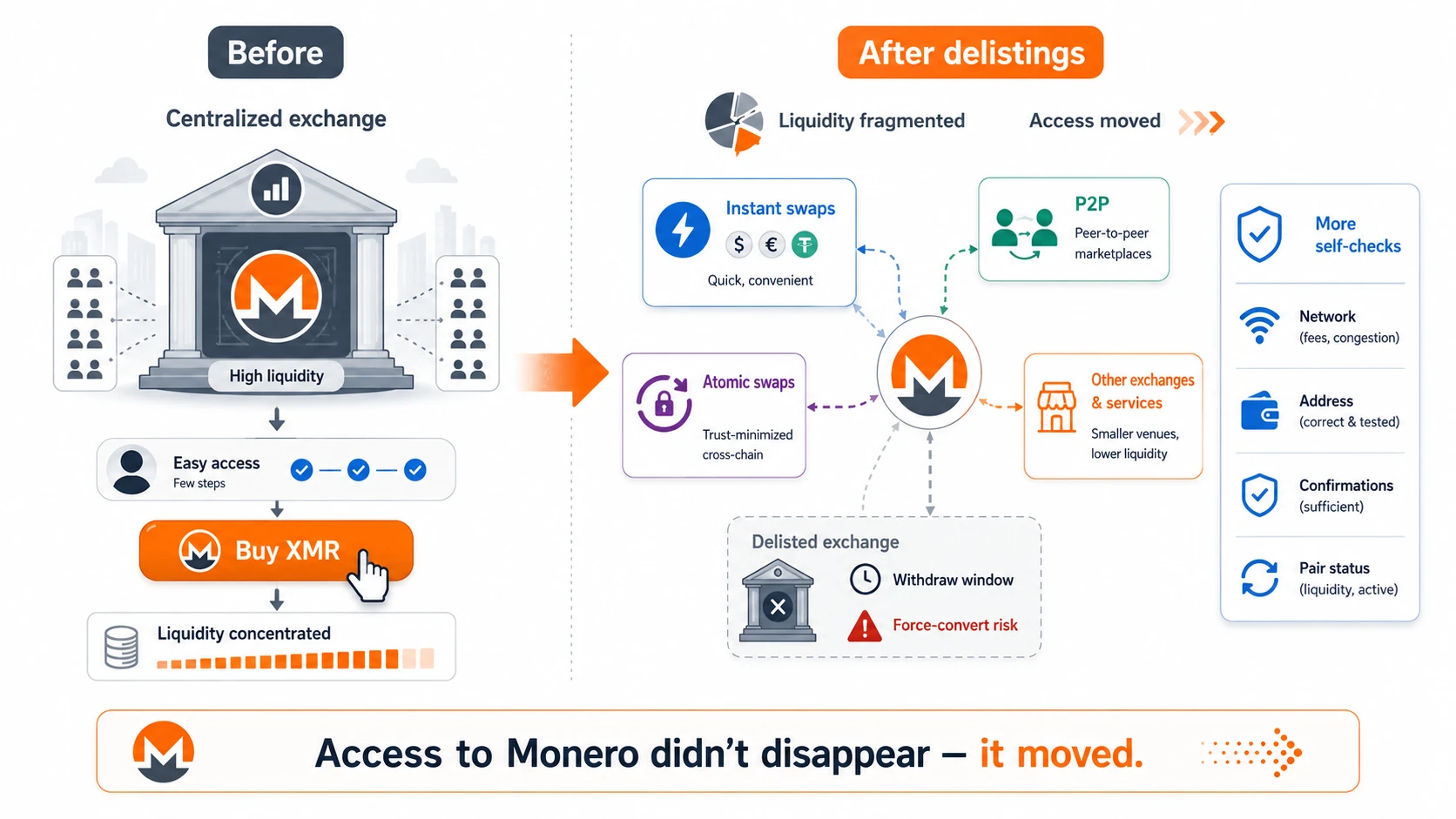
Convenience declined for those who preferred major centralized platforms, while the relative weight of non-custodial and lower-verification routes increased.
Which Major Exchanges Delisted Monero and When?
The following high-profile cases were documented in public announcements reviewed on 1 September 2026:
| Exchange | Action | Approximate Date | Scope | Official Source Type |
| OKX | Spot pairs removed | January 2024 | Global | OKX delisting announcement |
| Binance | Global spot delisting | February 2024 | Global | Binance official announcement |
| Kraken | Progressive restrictions → EEA removal | Mid-to-late 2024 | EEA | Kraken official notices |
| Additional platforms | Further delistings and restrictions | Throughout 2025 | Varied | Industry reporting of further removals |
Exact residual-balance handling and final withdrawal deadlines differed by platform.
Users affected by any delisting were generally given a defined period to move funds.
Readers should consult the original platform notices for the precise wording and timelines that applied at the time.
Where Can You Still Swap XMR in 2026?
As of the status check on 1 September 2026, Monero remains accessible through four main categories:
- Accountless instant swap services
- A reduced set of centralized exchanges that still list spot pairs
- Peer-to-peer markets
- Atomic-swap tools
Status is dynamic.
Regional restrictions, liquidity conditions and internal policy updates can alter availability without long notice.
Current Support Status Snapshot — 1 September 2026
The table below summarises the observed status of selected services on the review date. Users must re-verify every entry on the live platform before sending funds.
This is a selected status snapshot rather than a complete list of every platform supporting XMR. It focuses on representative services from different exchange models.
| Service | XMR Status — 1 Sep 2026 | Account Required | Custody Model | Main Practical Limitation | Check Source Type |
| Quickex | Supported | No | Temporary during execution | Risk-based AML possible; dynamic minimums | Live pair page |
| ChangeNOW | Supported | No account required to initiate the reviewed flow | Temporary during execution | AML review possible on flagged deposits | Service interface |
| StealthEX | Supported | No account required to initiate the reviewed flow | Temporary during execution | Verification possible on flagged orders | Service interface |
| Godex | Supported | No | Temporary during execution | Liquidity varies by pair | Service interface |
| KuCoin | Listed, spot | Yes | Custodial | Verification often required for full use | Exchange markets page |
| MEXC | Listed, spot | Yes | Custodial | KYC is required for trading, deposits and withdrawals; regional restrictions apply. | Exchange markets page |
| Gate.io | Availability requires live verification | Yes | Custodial | Regional availability varies | Exchange markets page |
| TradeOgre | Listed | Limited | Custodial | Current order-book depth and withdrawal availability must be checked before trading | Exchange markets page |
Accountless Instant Swap Services That Still Support XMR
These services allow a user to select a pair, enter a Monero receiving address, send the deposit asset to a one-time address, and receive XMR after processing.
The reviewed order flows could be initiated without creating a conventional account. Identity or source-of-funds verification may still be requested under the provider’s current compliance policy.
Swap processing time depends on the sending network and provider execution. After XMR is broadcast to the receiving wallet, newly received funds normally require 10 Monero confirmations before they become spendable.
Guidance on confirmations is available in the official Monero documentation.
Accountless services may still apply risk-based AML screening to incoming deposits, and flagged transactions may require additional review according to each provider’s published policy.
Quickex continues to support Monero pairs.
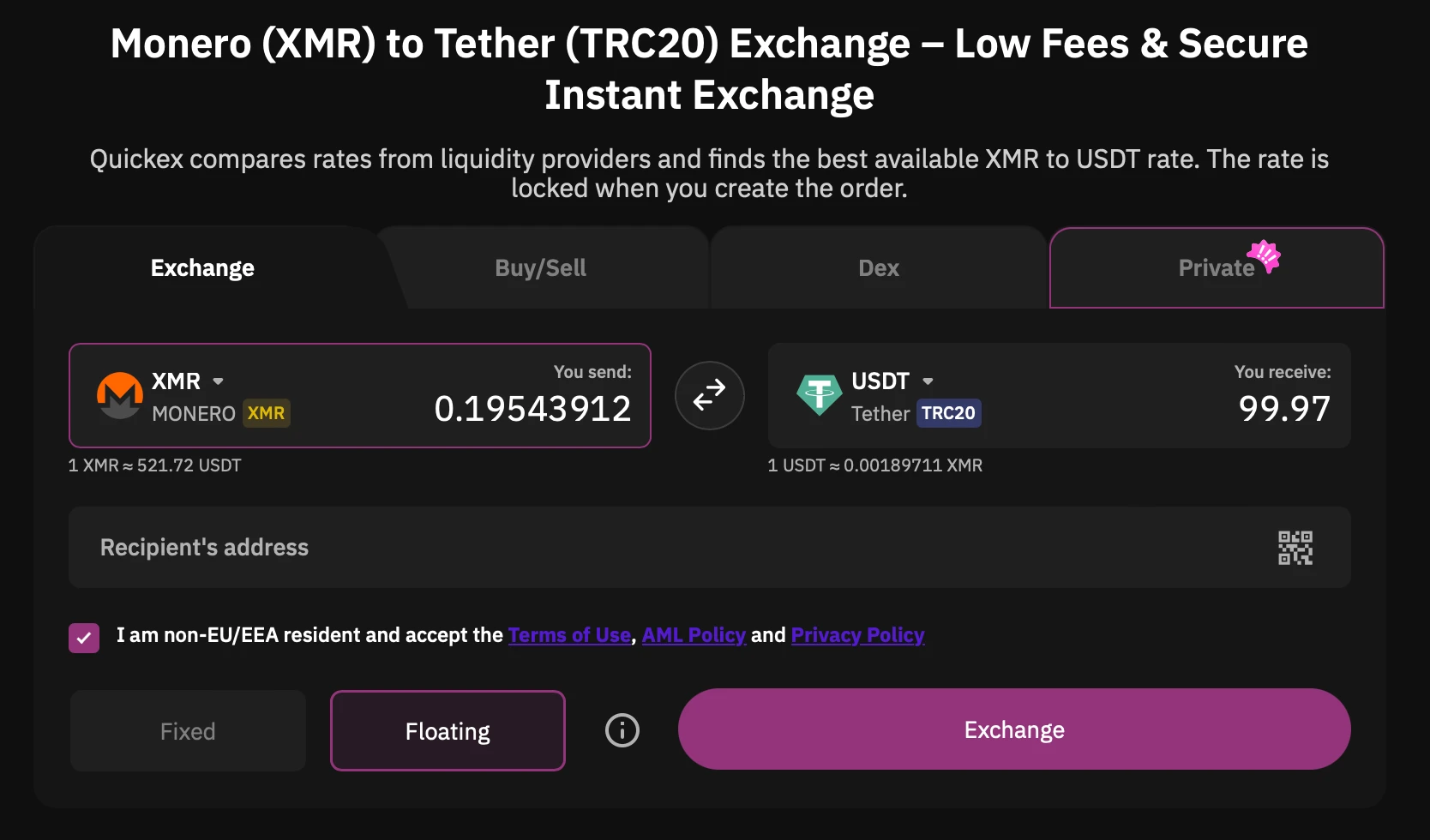
Users can move between XMR and stablecoins, including the route XMR to USDT TRC20.
ChangeNOW, StealthEX and Godex are additional accountless services that continued to offer XMR routes as of the review date.
Each service displays the currently available quote and minimum amount in its interface. Depending on the provider and pair, the rate may be fixed, floating or offered in only one format.
Pair availability, minimum amounts and quoted rates should always be confirmed on the day of the swap because conditions change with liquidity and network load.
Which Centralized Exchanges Still List Monero?
Public exchange markets and asset pages reviewed around 1 September 2026 continued to show Monero spot pairs on a limited number of centralized platforms.
KuCoin continued to list XMR pairs.
Full use of deposits, trading and withdrawals typically requires account verification.
Users should check the current markets page and any privacy-coin specific rules before depositing.
MEXC continued to list XMR.
Access, limits and withdrawal conditions are subject to regional rules and account status.
The live markets page is the authoritative source for current pair status.
Gate.io publishes XMR-related pages, but users must verify that spot trading, deposits and withdrawals are currently enabled in their jurisdiction.
Availability can vary by jurisdiction and account verification level.
Confirmation of deposit and withdrawal status on the official page is essential.
TradeOgre continued to list Monero.
Users should check the current order-book depth, deposit status and withdrawal availability before trading.
Because listings and withdrawal rules can change rapidly, the only authoritative source is each exchange’s own current markets or asset page.
Always verify deposit, trading and withdrawal status immediately before sending funds.
P2P and Atomic-Swap Routes
Haveno-based P2P markets use peer-to-peer matching and multisignature escrow.
These routes reduce reliance on a centralized custodian by using peer-to-peer matching and multisignature escrow.
Matching speed depends on available counterparties and can be slower than instant services.
Atomic-swap tools allow trust-minimized BTC–XMR exchanges between wallets.
They require greater technical familiarity and sufficient liquidity on both sides.
For users prioritising the lowest possible reliance on intermediaries, these remain relevant options after the centralized delistings.
Practical Steps and Risks
Recommended workflow after the delistings:
- Use a compatible self-custody Monero wallet.
- Generate a fresh subaddress for each incoming payment.
- Compare live quotes across one or two services or an aggregator.
- Confirm the exact network, especially for USDT variants, and the full receiving address.
- Start with a small test amount.
- Allow the required Monero confirmations before treating the funds as fully spendable.
- Retain records sufficient for personal tax compliance.
Key remaining risks:
- Address or network errors are irreversible.
- Risk-based AML screening can pause transactions even on accountless services.
- Liquidity and spreads on less popular pairs can widen.
- Regional access rules continue to evolve.
- Intermediate steps involving transparent assets remain visible on those chains.
FAQ
-
Where Can I Still Swap Monero After the Major Delistings?
Accountless instant swap services, a reduced set of centralized exchanges, P2P markets and atomic-swap tools continued to support XMR as of 1 September 2026.
Availability changes, so the live interface of any chosen service should be checked before sending funds.
-
Which Exchanges Still List Monero in 2026?
Public exchange pages reviewed around 1 September 2026 continued to show XMR spot pairs on selected platforms such as KuCoin, MEXC and TradeOgre. Gate.io availability requires separate live verification. Multiple accountless swap services also continued to support XMR routes.
Regional restrictions and verification requirements apply on many custodial venues; always verify the current asset or markets page.
-
Why Did So Many Exchanges Delist Monero?
Platform announcements and industry reporting point to regulatory and compliance pressure as the main driver.
Monero’s privacy features make it difficult for licensed custodial platforms to meet certain transaction-monitoring expectations linked to frameworks such as the FATF Travel Rule and regional regimes including MiCA.
-
What Changed for Ordinary Users?
Access shifted away from the largest global order books toward instant swaps, remaining mid-tier or regional centralized platforms, P2P markets and atomic-swap tools.
Users gained clearer separation from heavily regulated venues but assumed more responsibility for verifying current pair status and operational security.
-
Can I Still Swap XMR Without Creating an Account?
Yes — several accountless instant swap services continued to support standard XMR orders without registration as of 1 September 2026.
Risk-based screening may still apply to individual deposits according to each provider’s published policy.
-
Is It Still Legal to Hold Monero?
Monero delistings do not by themselves make private ownership illegal; legal treatment varies by jurisdiction.
Users should check the rules that apply in their own location before acquiring or transferring the asset.
Conclusion
The delistings of 2024–2025 removed Monero from many of the most convenient centralized trading venues, but they did not eliminate access.
As of 1 September 2026 the practical routes are more fragmented and more reliant on accountless instant swaps, a smaller group of remaining centralized platforms, P2P markets and atomic-swap tools.
Users who previously relied on a single large exchange now benefit from understanding the different custody models, confirmation requirements and compliance behaviours of the remaining options.
Checking live quotes, using self-custody wallets, verifying networks and addresses, and starting with small amounts remain the most reliable practices.
Status of pairs and policies is based on publicly available information reviewed on 1 September 2026.
Conditions change rapidly — always re-verify before transacting.


